The law that says ‘learn’ just got quieter
The EU has softened its duty to teach AI skills, just as AI starts to act on its own. Those skills decide who can trust it, thrive with it and build with it.
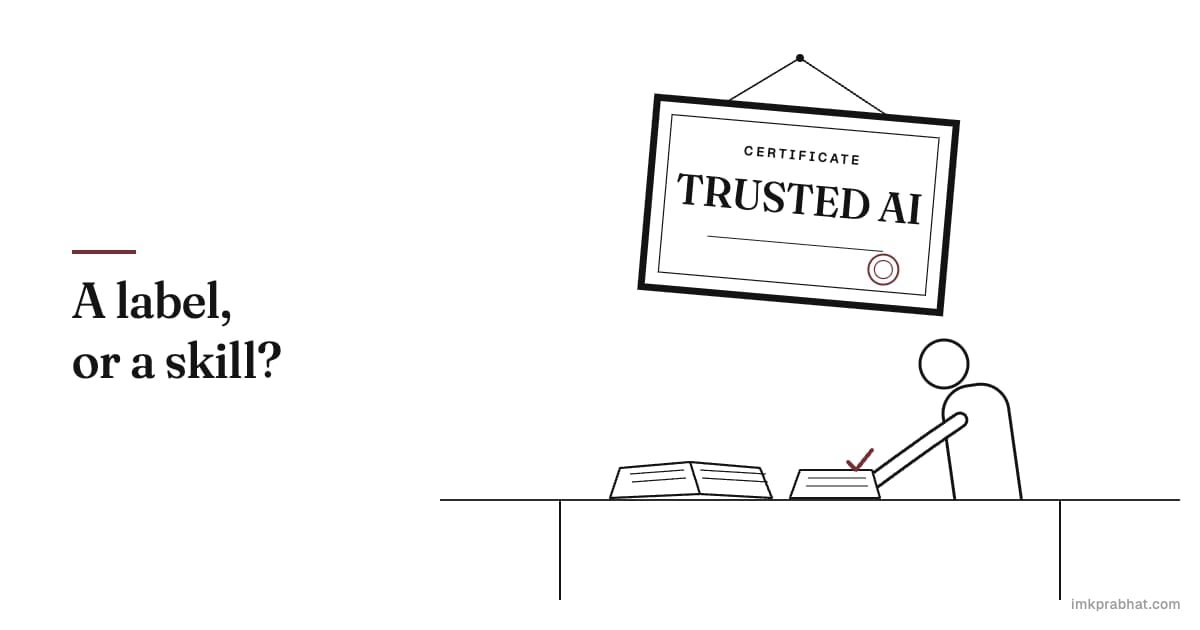
In June 2025, a solicitor in London had to explain himself to two senior judges.
His client was suing Qatar National Bank. The client had done some legal research of his own, partly with “publicly available artificial intelligence tools”. The solicitor used that research. He put the cases into a witness statement, the written account a court relies on, signed it and sent it in. He did not check them. When the court did, most turned out to be “made up or misunderstood”.
He accepted that he was wrong and reported himself to the body that oversees solicitors. He was not the villain of the story. He was a professional who trusted something that looked like law. Most of us have done a smaller version of the same thing, with an email or a summary we did not read twice.
The judges did not stop with him. They said the people who lead law firms and barristers’ offices must now take “practical and effective measures” so that every lawyer knows their duties. Someone, in other words, has to teach the skill.
The EU wrote that duty into law in 2024. This July, it made it quieter.
What I mean by AI literacy
People speak of AI literacy as if it were a course with a certificate at the end. I see it as three things a person can do.
The first is to check it. Know what the tool is good at and where it slips. Follow a claim back to something you can open and read. Say no to an answer that sounds right but is not.
The second is to use it well. A nurse who lets AI draft the shift handover, then reads it before signing, gets an hour back without giving up any judgement.
The third is to build with it. A teacher who makes a small quiz tool for their own class, or a shopkeeper who sets up a simple assistant for customer questions, is no longer waiting for someone else’s product.
The solicitor had the tool, and he had the confidence. What he did not have was the first of these: the habit of opening the source.
The honest teacher
Here in the Netherlands, ask a teacher about AI and you will often get an honest answer: I am not ready yet.
That is not a guess. The Dutch school inspectors, in their yearly State of Education 2026 report, say 88% of primary school teachers feel they do not yet have the knowledge and skills to use AI well in their teaching. Their pupils, as any parent will tell you, have no such doubts.
I trust the teachers’ doubt more than the pupils’ confidence. A teacher who admits to being unsure is asking the right question: when should I believe this machine, and when not? That question is the beginning of the skill. Confidence, on its own, is not.
So I would not hurry the honest teacher. I would give them the time and the training, because that doubt is worth more than a classroom full of easy certainty.
The teacher the class believes
Where I come from, in Bihar, in northern India, a teacher’s word carries real authority, in the classroom and well beyond it. When the teacher says something is true, the class writes it down.
That is why I was glad to see the order India chose. When the Central Board of Secondary Education (CBSE), India’s largest national school board, brought “Computational Thinking and Artificial Intelligence” into classes 3 to 8 this year, it also made understanding AI the training theme for its teachers. The teachers come first.
It is too early to say how well the training will land. But the instinct is sound. If the person the class believes learns when not to trust a machine, the class will learn it too, often without being told.
What the EU changed in July
Since February 2025, the EU’s AI law, the AI Act, has told every company that builds or uses AI to make sure its staff understand it. This July, a package of changes rewrote that rule. Here are the old and new words side by side.
Article 4, 2024
Providers and deployers of AI systems shall take measures to ensure, to their best extent, a sufficient level of AI literacy of their staff…
Article 4, from July 2026
Providers and deployers of AI systems shall take measures to support the development of AI literacy of their staff… This obligation does not require providers or deployers to guarantee any specific level of AI literacy of any individual.
I understand why. Small firms said the old rule was costly, and the new text admits as much. I have little patience for rules that only produce paperwork. But this change does not remove the paperwork. It removes the question of whether anyone learned. A firm can book a course, tick the box and move on, and nobody has to ask whether anyone learned anything. A softer rule saves a firm some cost this year. It does nothing for the people whose work will depend on these skills next year.
The new text even says AI literacy “should be a strategic priority, regardless of regulatory obligations and potential sanctions”. In plain words: do it because it matters, not because the law makes you. I agree with every word. It also means the law has handed the question back to us, and I would rather we answered it than waited for the next court to answer it for us.
When the AI stops answering
The solicitor in London had one advantage. The AI gave him an answer, and the answer sat on his desk until he signed it. He could have read it.
The AI arriving now does not wait on the desk. It acts on its own: it files the form, sends the payment, closes the case. A claims handler at an insurer may soon find her assistant settling small claims overnight. In the morning there is nothing to read before signing. There is only what has already been done.
So the skill grows. Checking an answer is still the start. Now the person also has to know what the tool may do on its own, see what it did, and be able to stop it, which is what I wrote about in the day you switch the AI off.
My rule, AI proposes and a person decides, still holds. It simply moves from the answer to the action.
What I would do on Monday
Think of the colleague who forwards an AI summary of a long contract every Friday. The summary is neat. Nobody opens the contract. One day the summary will be wrong, and nobody will know.
Checking is the floor, and the first thing I would test. Using or building on an answer nobody checked only spreads the mistake.
So if the law will not set a level, set your own. That is the idea behind ainsteins, which I founded, and behind AIforAll Global: the skill, not only the tool. Here is what I would do, for every role that relies on AI, once a year.
Trust test
Five checks before you trust AI at work
- Scope. Can the person say what this tool may and may not answer?
- Source. Can they trace a claim back to a source they can open?
- Challenge. Can they find a planted error in a real answer?
- Sign-off. Do they know when to refuse an answer, and who to ask?
- Stop. Can they switch it off, and carry on without it?
Each check takes an hour with real work. Give someone three AI answers from their own job, one with a mistake planted in it, and see whether they find it. If they miss it, do not send them on another course. Sit with them, open the source together, and try again next month.
Worth the hour
None of this is free. Someone has to prepare the answers with the planted mistakes, and small firms will feel the time most. A test once a year will not catch everything either. Some errors only show up with experience.
But think again of the solicitor in London. He learned the lesson in front of two judges, with his name in a public judgment. Most of us would rather learn it on a Monday morning, from a colleague, with nothing at stake.
The duty got quieter. The need did not.
If your team trusted an AI answer tomorrow, who taught them how to check it?