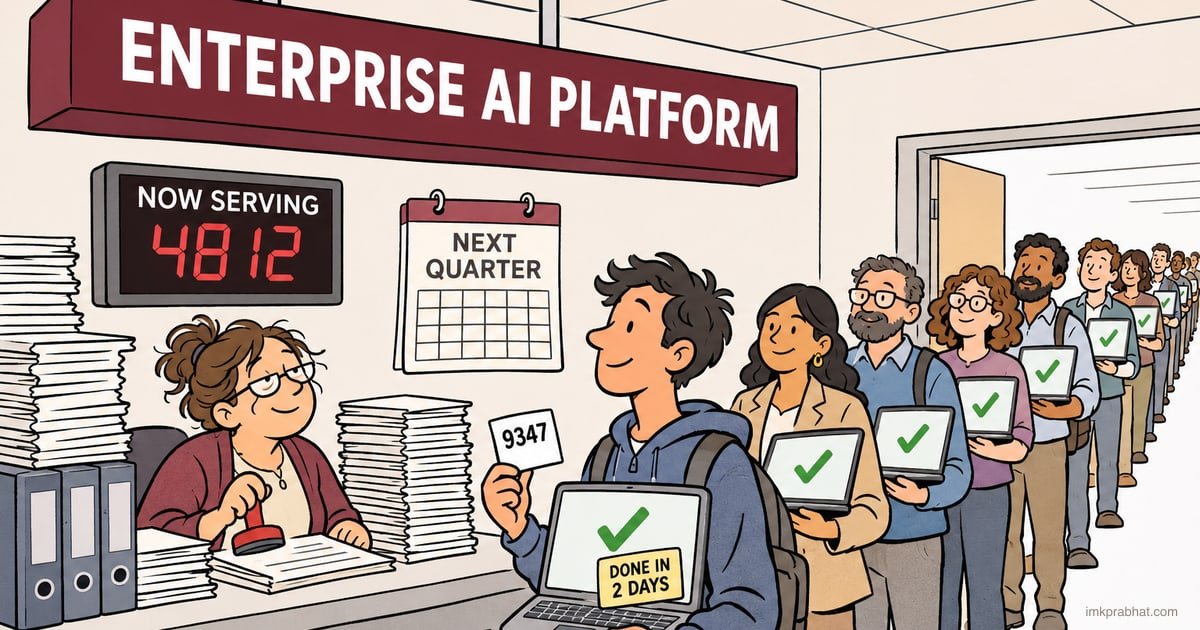
What Conway's law tells us about AI and the org chart
Organisations design systems that mirror how they communicate. AI is changing how they communicate.
I am seeing the same shift from two directions.
In the AIforAll Global community, where members work with the latest AI tools, individuals now complete in a weekend activities that used to take weeks.
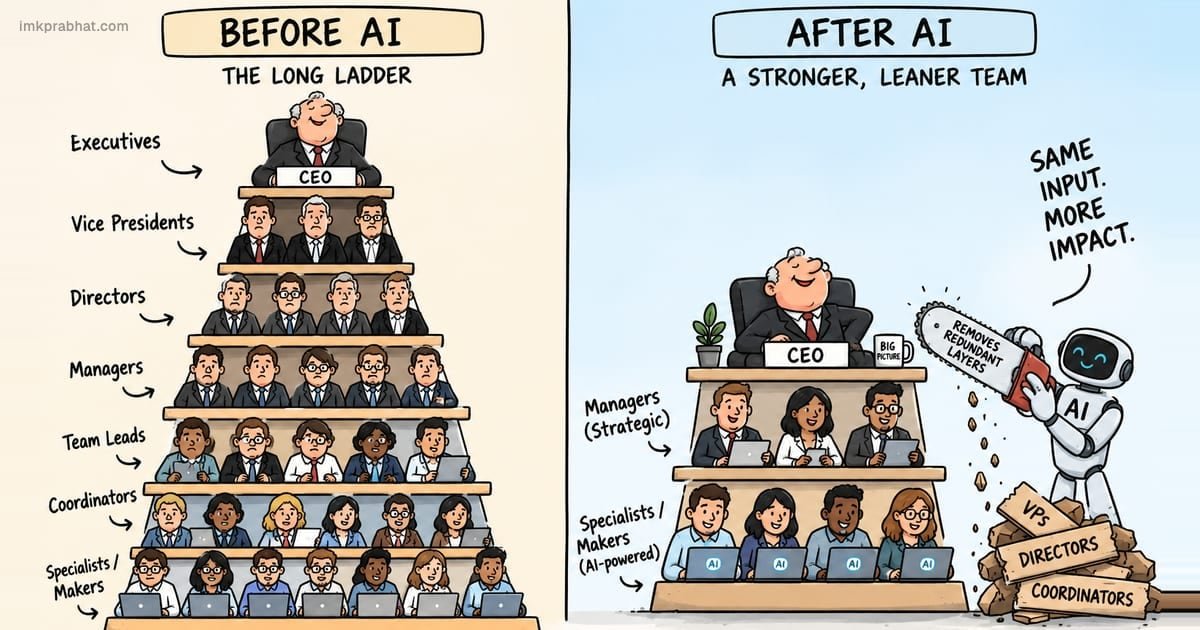
Through my professional network, I see organisations consolidating departments that were created to keep teams a manageable size for the work. My hypothesis: they consolidate the work first, intending later to reduce the capacity needed to do it.
My working principle is simple: AI proposes, a person decides. So here is the question I want to test: when AI makes communication cheap, what happens to an organisation’s shape, and do people still decide?
Your org chart is an architecture diagram
In April 1968, Melvin Conway published a short paper in Datamation, “How Do Committees Invent?”. Its thesis, in his own words: “Any organization that designs a system (defined broadly) will produce a design whose structure is a copy of the organization’s communication structure.” Fred Brooks later named it Conway’s law in The Mythical Man-Month.
As an experienced architect and an entrepreneur, I read the law in both directions. A company’s systems reveal its org chart, and its org chart predicts where its systems will be slow, duplicated or hard to change. The boxes and the lines are the same diagram, drawn twice.
By communication, I mean the work of moving understanding between heads: gathering status, summarising for the level above, translating one team’s language for another, drafting the brief, aligning in meetings. Conway’s “communication structure” is the paths that work takes: who talks to whom. Each step used to need a person’s time. Now a model reads everything, summarises in seconds, drafts the first version and translates between engineering, finance and the client, at close to zero cost, which is why there are more messages than ever. What AI makes cheap is moving information, not judgement.
Conway described how systems mirror organisations. I would take it one step further: when communication becomes cheap, the organisation’s own shape is free to change.
Takeaway: before you redraw the org chart, map how information actually moves today: who gathers it, who relays it and who decides.
Most of the middle is a message relay
Organisations did not build their layers by accident. A manager can lead only so many people well, so as work grew, teams were split and new layers appeared to coordinate them. A large part of the middle of the pyramid exists to move information: status up, priorities down, reports across.
In systems terms, those layers work like integration middleware. They collect messages from one part of the organisation, translate them and pass them on. Other layers do something different: they hold judgement. They weigh trade-offs, decide, and develop the people around them.
Software has been through this before. Manual hand-offs between systems gave way to interfaces that pass information automatically. AI is now doing the same for many hand-offs between people: gathering, summarising, drafting and reporting. The relay layer feels it first; the judgement layer still needs people.
Many organisations are already cutting layers. In Korn Ferry’s 2025 Workforce survey, “41% of employees told us that their organization has slashed management layers.”
Takeaway: test every layer with one question: does it carry information, or does it hold judgement?
When a prototype is cheaper than a description
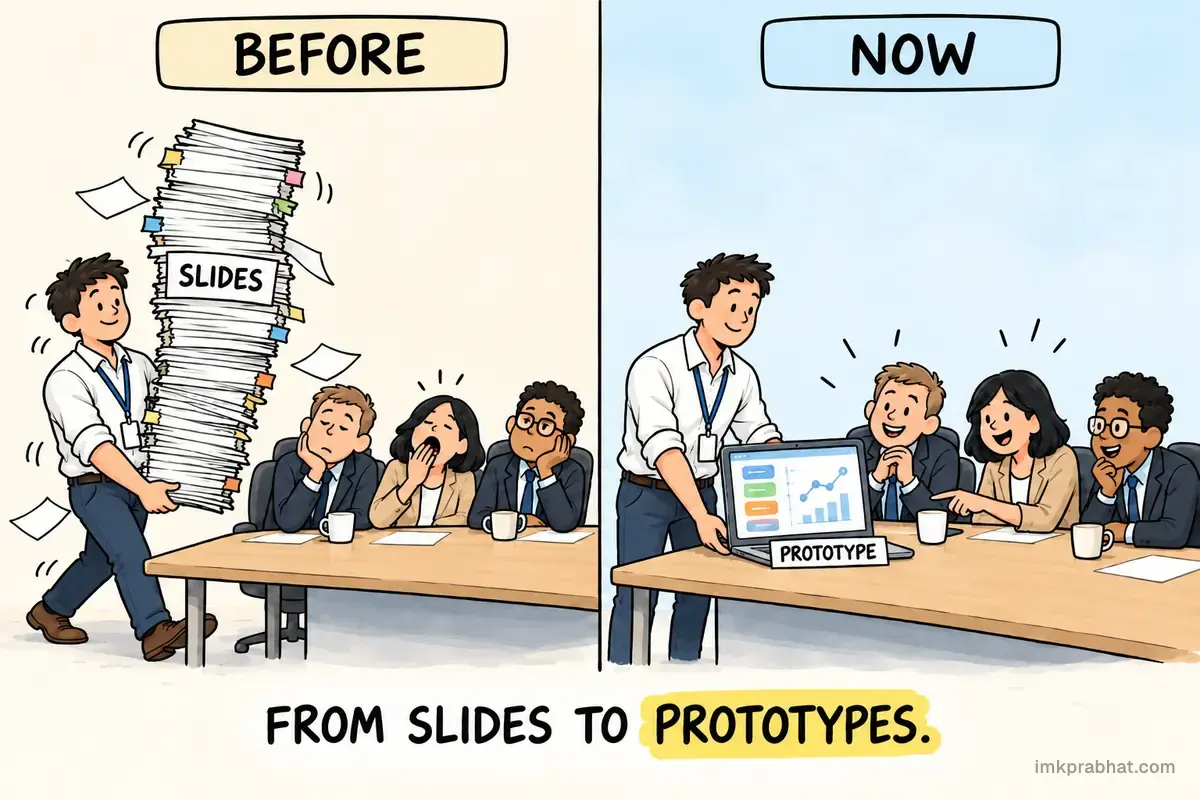
A slide deck is a relay too. In the AIforAll Global community, forward-deployed engineers, who build alongside the client, no longer bring one to an engagement; they bring a working prototype instead. To see why that matters, look at what the deck was for. A slide deck has a job: it describes something that does not exist yet, so that people can understand it, align on it and approve it. Whole layers of review and sign-off are organised around that job.
When building a working version costs less than describing it, the deck loses its job. People no longer need a description of the thing; they can use the thing. Many of the translation steps between the person with the idea and the person who decides can disappear with it.
The same is true of time. When the work itself speeds up, an approval cycle designed for the old pace becomes the slowest part of the system.
Takeaway: find the meetings, approvals and roles that exist to describe work rather than show it, and redesign them before they become the bottleneck.
Flatten on purpose: the inverse Conway manoeuvre
Conway’s law can also be run in reverse. In 2014, Thoughtworks’ Technology Radar described the “Inverse Conway Maneuver”, which “recommends evolving your team and organizational structure to promote your desired architecture.” For leaders, that means redesigning teams deliberately, so that the communication, and the systems, you want follow from them.
In Europe, that design comes with duties. If AI starts relaying information and allocating work, it can fall under the EU AI Act, which treats as high-risk AI systems used “to allocate tasks based on individual behaviour or personal traits or characteristics or to monitor and evaluate the performance and behaviour of persons” at work, from 2 December 2027. So a person has to stay accountable for what those systems do.
The Commission’s Quality Jobs Act consultation, which closed on 28 September, aims at “making automated decisions more transparent and human-centred, and protecting employees from excessive monitoring”. Change also runs through works councils and social partners: in France, Malakoff Humanis and four unions agreed in September that deploying an AI system cannot on its own be grounds for economic dismissal.
AI proposes, a person decides. In a flatter organisation, that principle is not a slogan. It is the design.
Takeaway: redesign teams for the communication you want, name who is accountable for every AI-assisted decision, and involve employee representatives before the restructuring.
The new way up
If the middle thins, what happens to the career ladder? People who expected to climb into a director’s role will ask, fairly, whether that role will still exist.
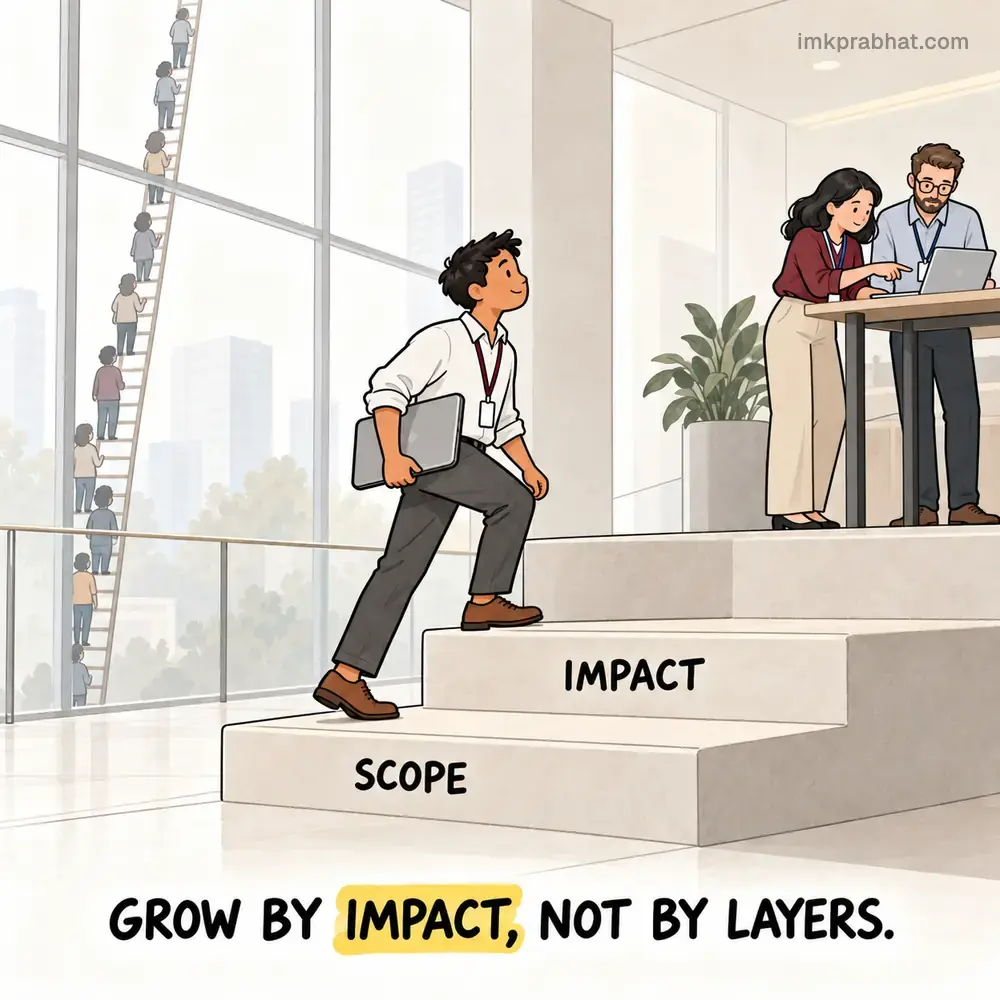
My answer: the new way up is scope and impact, not the number of people you manage. The engineer who brings a prototype grows by the size of the problems they can solve. The managers who remain grow by the quality of their decisions and the people they develop.
Flattening without design may already show up in the data. According to Gallup’s State of the Global Workplace 2026 report, “the largest year-over-year drop in manager engagement occurred between 2024 and 2025, when it declined by five points from 27% to 22%.” The steepest fall was in India’s region: “In 2025, South Asia (primarily India) experienced an eight-point decline in manager engagement, the largest decline of any region.” Gallup adds that “the percentage of managers in South Asia also declined, suggesting that employers are cutting management roles.”
The decline can be managed. A Gallup study of US managers found that “manager engagement declines with larger spans of control, though manager talent and training can offset this effect.”
Takeaway: create growth paths that do not require managing more people, and give the managers who remain the time and training that wider spans demand.
Fewer people, or more impact?
If my hypothesis is right, the transition will not be painless. Some cuts announced in the name of AI are simply cost-cutting, and the evidence on long-term effects is still early.
But I doubt that fewer people for the same work is where it ends. When people can do more, the work grows to meet them: more software, more prototypes, more ambition. William Stanley Jevons saw the same pattern in 1865, in The Coal Question: “The economy of labour effected by the introduction of new machinery throws labourers out of employment for the moment. But such is the increased demand for the cheapened products, that eventually the sphere of employment is greatly widened.” That is why I expect the likelier outcome to be the same people with more impact.
Work per person is already growing: Korn Ferry’s Workforce 2026 report found that “More than three in five employees (61%) now say they are performing the responsibilities of more than one role.” More work per person can mean more impact or more strain, and design decides which.
Either way, the relay layers will thin, because AI now carries much of what they carried. The choice is whether we design what replaces them or let it happen by accident, and the test of any flattening is simple: do people still decide?
Same input. More impact.
If you mapped how information really moves in your organisation, which layer would turn out to be a relay?